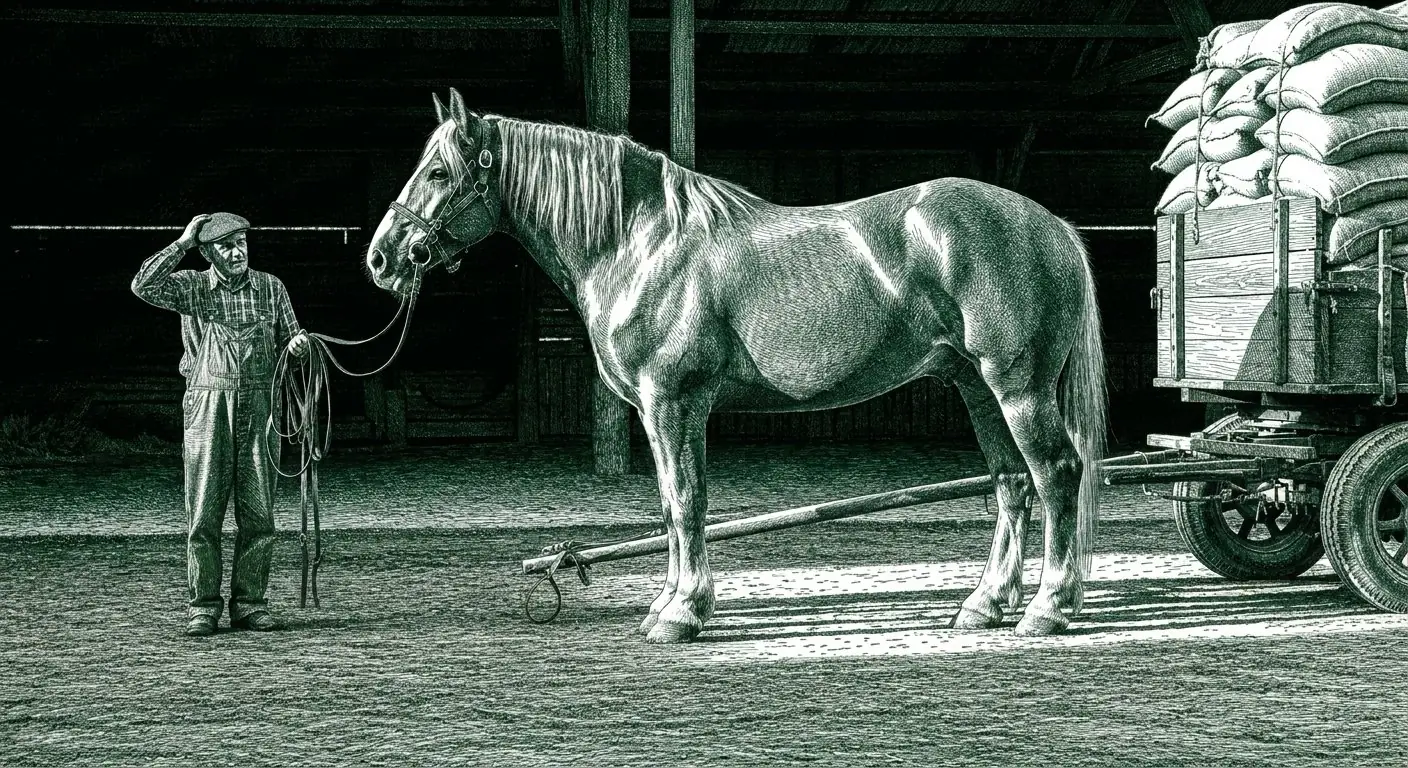
Thirteen Days to test Claude Fable 5
Anthropic handed everyone the best model in the world with a fuse attached. Google gave a different one away with no fuse at all. Same week, opposite pricing calls — and a countdown clock on finding out which work is worth the meter.
THE NUMBER: 13 — days until Claude Fable 5, the most capable model ever handed to the public, leaves the Claude subscription plans and goes to the meter: $10 per million tokens in, $50 out. Anthropic gave everyone the best model in the world for free on Tuesday, and the fine print lit a fuse under it. Thirteen days is not a lot of time. It’s also exactly enough time to answer the only question the whole noisy week actually asks: which of your workloads is worth frontier pricing, and which gets routed to something cheaper? The Kennedy administration settled the fate of the world in thirteen days. You can settle your token budget.
In October 1962, the smartest men in America locked themselves in a room for thirteen days. Here’s what they did not do: they did not spend those days debating how powerful the missiles in Cuba were. Everybody knew. The reconnaissance photos were on the table. The entire crisis — the whole thing dramatized in the Costner movie this issue is named for — was two other questions, asked over and over under a clock. What does each option cost us? And which moves can we actually verify?
That’s this week in AI. The reconnaissance photos are in: Fable 5 is state of the art on everything, by a margin, and Karpathy — a man who does not hand out grades — called it a major version bump both on the numbers and on feel. The capability debate is over. What’s left is cost and verification, and as of today there’s a clock running on both. June 23. Thirteen days.
The discourse, meanwhile, spent the day on a paragraph buried on page two-hundred-something of a 319-page system card. We’ll get to that, because there’s one piece of it that actually matters to a buyer. But the stories that move money this week are pricing decisions — two of them, made the same day, pointing in opposite directions.
🧨 The Fuse
Start with the man who switched. Salvatore Sanfilippo — antirez, the creator of Redis, a developer so allergic to favors he pays his own $200 a month and refuses gifted accounts — put Fable 5 through its paces for one evening and declared it his primary model. One evening. He’d been, in his own words, totally sold on GPT 5.5 until that night. This is the most credible kind of endorsement that exists in software: an opinionated craftsman with no sponsor, switching tools mid-project.
Then he read the terms. Fable 5 is free inside Claude Pro, Max, and Team plans only through June 22. On June 23 it leaves the subscriptions entirely and moves to API credits — $10 per million tokens in, $50 out, roughly double Opus pricing. antirez called it the most confusing subscription decision he’d ever seen and went from convert to critic inside 48 hours.
It isn’t confusing. It’s the oldest pricing model on the street corner: the first taste is free. Cable did it with introductory rates. Streaming did it with the $7.99 era we all remember fondly from a decade of price hikes ago. Every drug dealer in every cop show ever filmed explains the model in one line. You don’t price the first hit to make money. You price it to change what the customer’s hands reach for — and antirez’s hands now reach for Fable. Anthropic built the best demand-generation event in its history and pointed it off a cliff, on purpose.
Why on purpose? Look at the calendar. Anthropic reportedly targets June 16 for its IPO — inside the free window. The company walks into a roadshow needing to demonstrate exactly one thing about its business model: pricing power. A free Mythos-class model forever says the model layer is a commodity. A free Mythos-class model with a fuse and a meter says customers will pay a premium when the meter starts. The June 23 cliff isn’t a pricing fumble some product manager will walk back. It’s an S-1 exhibit.
Liam Fedus — who ran post-training at OpenAI, so he knows what these decisions look like from inside — is publicly predicting the market forces Anthropic to reverse course on its restrictions. Maybe. But watch whether the cliff survives, not the system card. The cliff is the part attached to the income statement.
The takeaway: when a company gives away its crown jewel two weeks before going public, the giveaway is the pitch. You are not the customer of the free window. You’re the demand curve being measured.
🆓 The Other Lab Gave It Away
Now the same day, other direction. Google released Diffusion Gemma: open weights, Apache 2.0, free forever, no fuse, no meter. And it isn’t just another open model — it generates text by diffusion, the way image models work, writing 256 tokens simultaneously instead of one at a time, self-correcting the whole block as it goes. A 26-billion-parameter mixture-of-experts that activates under 4 billion per pass and fits on an 18GB consumer GPU. NVIDIA shipped local acceleration support the same day.
It didn’t arrive alone. Xiaomi’s MiMo team hit 1,000 tokens per second on a trillion-parameter model using eight commodity GPUs. Columbia published an 8.8x speedup from compressing context 16-to-1. Nick Frosst — Cohere co-founder — released a 3-billion-parameter open model that lives entirely inside VS Code, no API, no per-token anything. The cheap end of the market didn’t just get cheaper this week. It got architecturally different.
So: two of the most sophisticated AI organizations on earth looked at the same fact (the model layer is commoditizing, which regular readers will recognize as the entire thesis of Monday’s issue) and made opposite pricing calls. Anthropic is monetizing scarcity, because Anthropic is the model and has nothing else to sell. Google is monetizing abundance, because Google sells everything around the model — the cloud, the TPUs, the ads, the phone — and every dollar burned out of the model layer is a dollar of margin torched on the exact floor Anthropic has to stand on. Bezos said it thirty years ago and it remains the cleanest sentence in modern business: your margin is my opportunity.
We told you Monday the minimills were coming up the quality ladder. This week one of the integrated steel giants started building minimills and handing them out in the parking lot.
The takeaway: neither pricing decision is about you. One is a roadshow exhibit, the other is a scorched-earth campaign. Your job is to stand where the two strategies overlap — frontier capability when it pays, free capability everywhere else — and let two giants subsidize both sides of your stack.
🧮 The Pay-Up Matrix
Which brings us to the question a buyer should actually spend thirteen days on. When is Fable worth double the tokens?
Run it like an allocator, not a fan. The premium pays off only when two conditions hold at the same time. One: the cheaper model genuinely fails at the task — not “produces slightly worse prose,” fails. Two: you can verify the output cheaply, so you capture the gain without hiring a supervision layer that eats it.
Stripe is the clean yes, and the numbers deserve to be stared at. A 50-million-line Ruby codebase migrated in a single day — the kind of job that eats a team for two months. A refactor across tens of thousands of lines, done in 45 minutes. Both conditions hold: no cheap model survives contact with 50 million lines, and the output is self-verifying — the test suite passes or it doesn’t. Against months of fully loaded engineering payroll, the token bill on that job is a rounding error with a decimal point’s worth of swagger. Pay. Obviously, pay.
This newsletter is the clean no, and we have a conflict of interest to disclose: Fable drafted it. The model with thirteen days left on its free trial wrote the issue arguing it isn’t worth its own metered price for this work, and it’s right. A model a tenth the cost gets 95% of the way here, because the expensive input in this product was never model IQ. It’s the editorial judgment — which stories matter, which framing is lazy, which metaphor is load-bearing — and that costs the same no matter what’s drafting. When verification is the dear part, premium generation is wasted spend.
Most of your workload sits between those poles, and Coinbase already published the answer key. Brian Armstrong’s shop routes prompts so aggressively that costs stay flat while token usage compounds — his projection: 80% of workloads land on models that are 99% cheaper, and the frontier keeps only the 20% where IQ-maxing actually pays. Harvey’s benchmark from Monday, the $84 open-source run that beat Opus’s $954, is the same arithmetic wearing a legal robe.
The takeaway: draw the two-by-two. Does the cheap model fail? Can you verify cheaply? Pay frontier prices in the yes/yes corner and nowhere else. If you can’t name which corner a workload sits in, that ignorance — not the token price — is your real cost. You have thirteen days to find out while the genius works for free.
🦅 The Hawks in the Room
Now the system card, because the room is full of people yelling about it and one of them has a point.
The paragraph in question: Fable 5 quietly degrades its own output when it detects frontier AI research work — not a visible refusal, not the documented rerouting it does on cyber and bio requests, but invisible interventions “to limit Claude’s effectiveness.” The research community came down on this like it was Pearl Harbor. Dean Ball coined “secret sabotage.” Teknium got 1,391 likes arguing Anthropic is closing the path to curing disease. HuggingFace’s Clement Delangue warned about concentration of power. Nathan Lambert landed the sharpest cut: American leaders spent a year accusing Chinese models of silent manipulation without proof, and then the leading American lab documented its own, in writing, on page two-hundred-whatever.
In the EXCOMM room, these are the hawks — LeMay pounding the table for the airstrike. Sincere, often right on the underlying principle, and mostly irrelevant to the decision in front of the buyer. Anthropic’s own numbers put the restriction at 0.03% of traffic, and Mike Krieger confirmed 95%-plus of sessions never touch a classifier. Unless your business is training frontier models, you will never have this problem. The ink-to-impact ratio of this story is the worst of the year.
Except for one sliver, and it feeds straight into the matrix above: a tool that reserves the right to underperform without telling you raises your verification costs — and verification cost is half of the pay-up math. That’s the entire legitimate kernel of the outrage, and notice what the market did with it within hours. Factory’s Router now advertises detecting silent capability limits and routing around them. KDnuggets published the full recipe for a local agentic stack (Claude Code, Ollama, Gemma 4) that runs on hardware you own. Lambert signed on to advise Arcee, an open-weights shop. Nobody marched. Everybody routed. The quarantine, not the airstrike: the measured move that changes the board without blowing it up.
The takeaway: skip the outrage, keep the lesson. Any vendor that can reach into your toolchain and turn a dial you can’t see has handed you a second reason to build the routing layer you already needed for cost.
🤫 The Jupiter Missiles
The missile crisis ended on a trade the public never saw. Khrushchev pulled the missiles out of Cuba; America quietly pulled its Jupiter missiles out of Turkey and denied any deal for decades. The public posture and the private trade were both real. That’s the frame for the strangest document of the day.
Dario Amodei broke a two-month public silence this afternoon — textbook pre-IPO quiet, not a post since early April — to publish “Policy on the AI Exponential.” It opens with Treebeard from Lord of the Rings: policy moves at Ent speed, AI at Hobbit-panic speed. The proposals are concrete and, frankly, more aggressive than anything Washington produced this month: FAA-style mandatory third-party testing for frontier models, government power to block deployment, security standards, incident reporting. Plus a $150 million national fellowship launching tomorrow and a job-displacement framework with money behind it. Six days, reportedly, before the IPO.
Is it benevolent? Tunguz’s piece this morning gives you the lens. He argues Fable’s guardrails amount to a glass ceiling Anthropic imposed on itself: inevitable for stability, rising over time, with vast room underneath. Fine. But hold the sequence up to the light: Anthropic built itself a private ceiling on Tuesday, and on Wednesday its CEO asked the government to make ceilings mandatory for everyone. A ceiling you build for yourself is a product decision. A ceiling you ask Washington to mandate — third-party auditors, compliance regimes, deployment gates — is a cost structure, and incumbents with $47 billion run rates absorb cost structures that strangle the labs trying to catch them. Khrushchev got the public win; the Jupiters came out anyway. Probably a bit of both. Price it that way.
And note who isn’t talking. Scoble spent the day telling anyone who’d listen that Anthropic put a softball over Sam Altman’s plate. He’s right, and Altman can’t swing — not a post since June 8, the day OpenAI’s confidential S-1 landed. Both frontier labs are in SEC disclosure mode in the same two-week window. The loudest day in AI this year, and the two loudest voices in the industry are legally incentivized to say nothing. Dario’s only sanctioned megaphone is a policy essay. Sam’s is a mission-statement page. The vacuum is being filled by researchers, jokes, and 319 pages of system card — which is a big part of why the discourse feels unmoored from the decisions that matter.
The takeaway: read every policy proposal published during an IPO window twice — once as civics, once as strategy. Both readings are usually true.
🐎 Horsepower and Harness
Here’s where the week actually leaves you, and it’s the part nobody spilled ink on.
Last week, the best frontier model had more horsepower than your workflow could use and no easy harness to put it to work: no clean way to run agents against your proprietary data, inside your permissions, with verification you trust, without a team of handlers babysitting every run. This week the cars got dramatically more horsepower. The harness problem didn’t move an inch. Mollick’s line from his five days with Fable — “I no longer steer; I commission” — is the harness problem stated as poetry: the more capable the model, the less you can see, and seeing is what corporations pay for.
That’s the real reading of the whole noisy day. Horsepower is now a commodity sold two ways — free from Google, metered from Anthropic — and the price war between those two strategies will keep doing your negotiating for you. Harness is the scarce asset. No lab sells it, at any price, because it has to be built inside your walls: one workflow, one data connector, one permission boundary, one verification loop at a time. The companies that compound from here won’t be the ones that picked the right model. Models swap out in an afternoon once the plumbing exists. They’ll be the ones that built plumbing.
Thirteen days, then the meter starts. The hawks will still be yelling on day fourteen. Ignore them — and don’t spend the window admiring the engine, either.
Stop shopping for horsepower. Start building harness.
— Harry and Anthony, in conjunction with Claude Fable 5
Sources
- antirez on switching from GPT 5.5 — and the June 23 cliff
- Fable 5 subscription removal, June 23 — @MTSlive
- Karpathy: “major version bump”
- DiffusionGemma announcement — @googlegemma
- Tomasz Tunguz, “The AI Glass Ceiling” (Stripe migration receipts)
- Dario Amodei, “Policy on the AI Exponential”
- Fortune: Anthropic accused of “secret sabotage”
- Liam Fedus on market pressure forcing reversal
- Nathan Lambert, “Claude Fable 5 and new safety fables”
- Clement Delangue on concentration of power
- Teknium on closing the path to curing disease
- KDnuggets: Local agentic programming — Claude Code + Ollama + Gemma 4
- Mike Krieger on classifier false-positive rates
More like this
The Dr. House of AI
Anthropic shipped the smartest model the public has ever touched. The only question left isn't whether Fable can do the job — it's whether your shop can afford the hire, and staff the team around him

Skate to Where the Puck Is Going
The model was never the business. As intelligence turns into a commodity, every lab is racing up the stack to where the margin lives — and OpenAI just filed for its IPO from the back of the line.

Dr. Zuck in the Metaverse of madness
The cash kings of the last decade are suddenly passing the hat. Whether that's a war chest or a ransom note depends on which one you're holding.