
OpenAI Guarantees PE Firms 17.5%. The Bonfire Gets a Bigger Tent
THE NUMBER: 17.5% — the guaranteed minimum return OpenAI is offering private equity firms to raise $4 billion in new capital. For context, the S&P 500 has averaged 10.5% annually over the last decade. When a pre-IPO company expected to go public at over $1.5 trillion has to promise returns that beat the market by 70% just to get investors in the door, the incentive structure is telling you something the press release isn’t.
The Opening
Two stories landed today that look separate but aren’t. OpenAI is offering PE firms a guaranteed 17.5% return with downside protection to raise $4 billion. And OpenAI is rolling out ads across ChatGPT to 900 million weekly active users at $60 CPM with a $200,000 minimum buy. Early partners include Shopify (NYSE: SHOP), Target (NYSE: TGT), and Adobe (NASDAQ: ADBE).
💲 Follow the money and you see the full picture. OpenAI burned through roughly $14 billion last year on approximately $10 billion in revenue. After a $110 billion raise in February that pushed the valuation to $840 billion, the cash still isn’t enough. So now they’re guaranteeing PE firms returns that would make a hedge fund blush, and bolting an ad engine onto the product that was supposed to be the gateway to artificial general intelligence.
Charlie Munger said it best: show me the incentives and I’ll show you the behavior. The incentive here isn’t to build AGI. It’s to keep the tent standing.
Meanwhile, on the other side of the industry, the agent era is arriving without any of the infrastructure it needs. 🦞 Harrison Chase (LangChain CEO) tweeted today about a fundamental distinction most companies haven’t even considered: there are two completely different types of agent authorization, “Claws” (fixed credentials, the agent acts as itself) and “Assistants” (user credentials, the agent acts on your behalf). Most companies deploying agents don’t understand this yet. One of us tried to buy a pair of slides from a Shopify store using an agent yesterday. Got all the way to checkout. The agent didn’t have a wallet. There was no agentic path into the store at all. The agent did exactly what a human would have done, click by click, at exactly the same speed.
The biggest AI company in the world is scrambling for cash while selling ads. The agent revolution has no plumbing. These are connected. The money is flowing to valuations while the infrastructure remains unbuilt.
💲 The $840 Billion Carnival: OpenAI’s PE Play Is a Distribution Deal in Disguise
Sam Altman’s OpenAI isn’t raising $4 billion because it needs more capital. It raised $110 billion six weeks ago. It’s raising $4 billion because of who’s writing the checks.
Private equity firms don’t just invest. They own companies. Hundreds of them. When Thoma Bravo or Vista or Silver Lake puts money into OpenAI with a guaranteed 17.5% floor, they’re not betting on an IPO pop. They’re buying the right to standardize OpenAI across every portfolio company they control. You give me money, I give you a guaranteed return and early model access, and your companies stop evaluating Anthropic and Google. It’s a channel play dressed as a fundraise.
This is a normal move in the deal business. If you’ve ever seen Sequoia go to a large LP and say “I’ll cut my fees and give you co-invest rights if you lock up a bigger allocation,” you know the playbook. The difference is Sequoia is in the deal business. OpenAI was supposed to be in the AGI business.
Except now they’re in the ad business too. ChatGPT is rolling out ads to free and Go-tier users. $60 CPM. $200K minimum buy. The manifesto we quoted just last week applies directly here: “If your revenue comes from advertising, your incentive is to keep people scrolling.” When the model starts recommending products, how will you know which answer is for you and which is for Shopify?
Here’s the part nobody’s connecting. The model layer is commoditizing underneath all of this. Chinese open-source went from 1.2% to 30% of global usage in a single year. Cursor just got caught running Kimi K2.5 (a Chinese model at one-eighth the cost of Claude) inside Composer 2. That’s their second concealment in four months. Cursor didn’t hide Kimi for national security reasons. They hid it because token cost is their only cost, and Kimi is cheaper. If the model layer is becoming a commodity, what exactly is an $840 billion valuation pricing in?
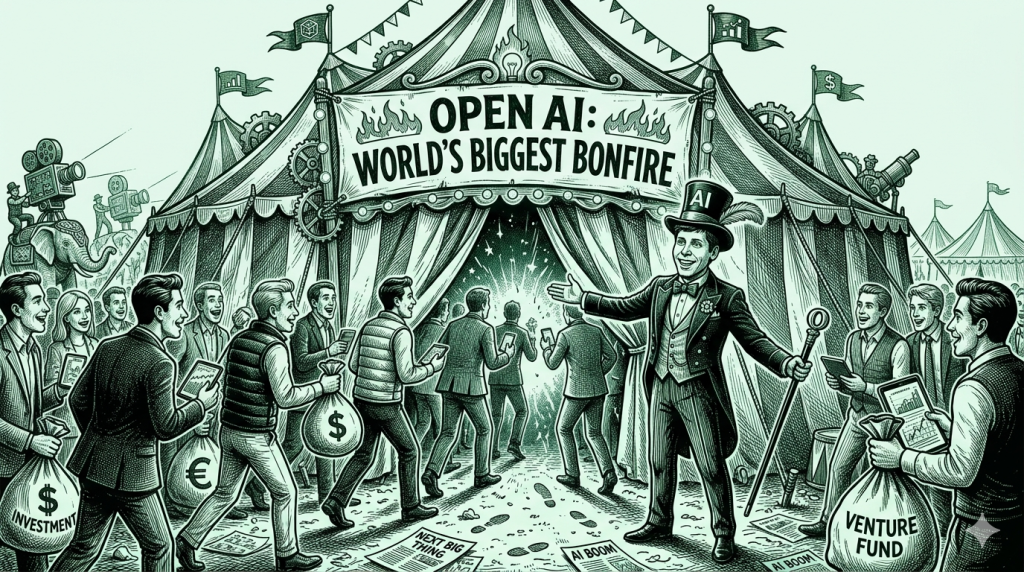
Sam Altman has changed the story more fluidly than the currents in San Francisco Bay. Nonprofit to capped-profit to for-profit. Safety-first to “move fast.” Research lab to ad platform. If you had to cast him, you wouldn’t reach for a lab coat. You’d reach for a carnival barker’s uniform. PT Barnum expanding the tent, promising a seat for every ass, changing the act whenever the crowd gets restless.
The signal for builders: The 17.5% guarantee tells you OpenAI’s organic growth story isn’t closing investors on its own. The ads tell you the subscription model isn’t covering costs. If you’re building on OpenAI’s APIs, understand that your platform partner’s incentives just shifted from “make the best model” to “keep the tent standing.” That’s a vendor risk conversation your team should be having this week. Anthropic raised straight equity, no guarantees, no downside protection. That’s not just confidence. It’s alignment.
🦞 The Agent Revolution Has No Plumbing
Yesterday, one of us tried to buy a pair of slides from Namu Recovery using an AI agent. The agent navigated the site, found the product, selected the size, and got all the way to checkout. Then it stopped. No wallet. No payment credentials. No agentic API to call. The agent had done exactly what a human would do, clicking through Chrome, reading the page, filling in forms, at exactly the same speed. That’s not automation. That’s cosplay.
And it gets worse. When we asked Claude how to improve the experience, the answer was honest: there is no agentic path into that Shopify store. The only option is the browser extension, manually navigating a UI designed for human eyes and human clicks.
This is the state of agent infrastructure in March 2026. Jensen Huang told every company at GTC they need an OpenClaw strategy. OpenClaw has 250,000 GitHub stars. But Harrison Chase (LangChain CEO) tweeted today about what’s actually missing: agent authorization doesn’t have standards. There are two fundamentally different models, “Claws” (the agent acts with fixed credentials, as itself) and “Assistants” (the agent acts on behalf of a user, with delegated credentials). Most companies deploying agents haven’t even thought about the distinction, let alone built for it.
Think of it this way. You can walk to town in your sneakers along the sidewalk, or you can drive. The rules for getting there and back are largely the same, but one is orders of magnitude faster. Now imagine you send your daughter to the store to fetch lunch. You never break stride and lunch appears like magic. But she needs your credit card (probably in your name) and your order. The delegation works because there are systems in place: a card issuer, a payment network, a receipt, trust.
Agents don’t have any of that yet. No wallets. No delegated payment credentials. No micropayment rails for the thousands of tiny transactions agents will make. No discovery layer (how does an agent find the right store?). No structured data feeds built for machine consumption instead of human browsing. No verification protocols. We need, essentially, a mirror image of the internet, built from an agent’s perspective.
Meanwhile, companies are charging ahead anyway. Mark Zuckerberg is reportedly training an AI agent to do his own CEO job at Meta (NASDAQ: META). Meta employees have already deployed their own agents that talk to each other autonomously, and one triggered a SEV1 security incident. Meta’s also tied AI tool adoption to performance reviews for 78,865 workers. The speed is there. The governance is not.
Why this matters: Having an “OpenClaw strategy” without understanding agent authorization is like having an “internet strategy” in 1998 without understanding HTTP. The opportunities will be enormous, but we’re in the earliest innings. If you’re an allocator, the infrastructure layer (auth, payments, discovery, data formatting) is where the next wave of value creation lives. If you’re an operator deploying agents, write your permissions policies now. Don’t wait for a SEV1 to force the conversation.
What This Means For You
The two biggest stories in AI today are connected by the same thread: the money is flowing to the wrong places. $840 billion for a company that has to bribe investors and sell ads. 250,000 GitHub stars for an agent framework that has no plumbing underneath it. The hype is ahead of the infrastructure, and the infrastructure is where the real value will compound.
Stop treating model selection as your most important AI decision. The model layer is commoditizing. Chinese open-source went from 1.2% to 30% in a year. Your agent’s authorization model, payment rails, and data architecture matter more than which LLM you’re calling.
Treat the OpenAI PE deal as a vendor risk signal. When your platform partner’s incentives shift from model quality to revenue diversification, your dependency becomes their leverage. Review your API contracts and evaluate alternatives before you’re locked in through a PE firm’s portfolio mandate.
Build agent infrastructure before you scale agent deployment. The companies that win the agent era won’t be the ones that moved fastest. They’ll be the ones that built the trust layer: auth, wallets, permissions, audit trails. Speed without governance is how you get a SEV1 at 2 AM.
The model wars make headlines. The infrastructure wars make money. Position accordingly.
Three Questions We Think You Should Be Asking Yourself
If OpenAI has to guarantee PE firms 17.5% just to raise $4 billion, what does that tell you about the organic demand for their equity? Six weeks after a $110 billion round at $840 billion, they can’t raise $4 billion on the strength of the story alone. Either the smart money sees something the headline valuation doesn’t reflect, or the deal terms are buying distribution, not conviction. Either way, if you’re building on their platform, you should understand which one.
Does your company have an agent authorization policy, or are your employees making it up as they go? Meta tied AI adoption to performance reviews and got a SEV1 from autonomous agent-to-agent communication nobody planned for. The question isn’t whether your people are deploying agents. They are. The question is whether you know what permissions those agents have and who’s accountable when they break something.
What happens if AGI becomes electricity? That’s the question nobody in Silicon Valley wants to ask out loud. Utilities generate utility-like returns, and they get capped by politicians everywhere. Watch the signals: Anthropic turned down the Pentagon. Grok and OpenAI happily signed on the dotted line. And while that was playing out, Claude was the model Palantir (NYSE: PLTR) was using to help target strategic sites in Iran. At some point, AI becomes so vital for national security and economic dominance that the government steps in and does what it’s always done with essential infrastructure: nationalizes it, or (like defense contractors) allows it to flourish with an understanding. Railroads, telecom, defense. Every technology that becomes the backbone eventually gets a leash. If you’re investing at an $840 billion valuation, you should be modeling that scenario.
Every crowd has a silver lining.”
— P.T. Barnum
— Harry and Anthony
Sources
- OpenAI 17.5% guaranteed PE return details
- High Yield Harry on OpenAI deal terms
- Compound248 on OpenAI financial analysis
- Harrison Chase on agent authorization: Claws vs Assistants
- ChatGPT ads rollout: Shopify, Target, Adobe as early partners
- Cursor concealing Kimi K2.5 in Composer 2
- Chinese open-source model growth data
- Meta agent deployment and SEV1 incident
- Mark Zuckerberg training AI CEO agent
- Jensen Huang GTC keynote: OpenClaw strategy mandate
- OpenAI $110B raise at $840B valuation, February 2026
Past Briefings
Jensen Huang Just Told Every Company What to Build. Most Aren’t Listening.
THE NUMBER: 250,000 — GitHub stars for OpenClaw in weeks, not years. Jensen Huang called it the most successful open-source project in history and the operating system for personal AI. Every enterprise company, he said, needs an OpenClaw strategy. But the real question isn't whether you have one. It's whether your business can even be read by one. At GTC last week, Jensen Huang didn't just announce products. He announced a new competitive requirement. Every company needs a claw strategy — a plan for deploying AI agents and, just as critically, a plan for making their business accessible to the...
Mar 19, 2026The Moat Was the Cost of Building Software. Claude Code Just Mass-Produced a Bridge
THE NUMBER: $100 billion — The amount Jeff Bezos is reportedly raising to buy manufacturing companies and automate them with AI, per the Wall Street Journal. Yesterday we wrote about Travis Kalanick's Atoms venture — $1 billion raised on a $15 billion valuation to bring AI to the physical world. Today one of the richest people on the planet walked into the same room at nearly 100x the scale. The atoms economy just got its first mega-fund. A VC told Todd Saunders something this week that lit up X like a signal flare: "The moat in software was the cost...
Mar 18, 2026Bill Gurley Says the AI Bubble Is About to Burst. Travis Kalanick’s Timing Says He’s Right.
THE NUMBER: $300 billion — HSBC's estimate of cumulative cash burn by foundational AI model companies through 2030. Bill Gurley sat on Uber's board while it burned $2 billion a year and says it gave him "high anxiety." OpenAI and Anthropic make Uber's bonfire look like a birthday candle. "God bless them," Gurley told CNBC. "It's a scary way to run a company." Travis Kalanick showed up on the All-In podcast this week with a new robotics venture called Atoms and opinions about who's winning the autonomy race. That's the headline most people caught. But the deeper signal is the...