
How Sam Altman just executed the tech industry’s most audacious talent heist
The OpenAI CEO convinced Jony Ive to bet his legacy on AI hardware—while Apple stagnates, Microsoft follows and Google stumbles
When Jony Ive walked away from Apple in 2019, Silicon Valley held its breath. The man who designed the iPhone—the device that redefined human interaction with technology—was free to work with anyone. Google’s billions beckoned. Meta’s metaverse promised new frontiers. Microsoft’s enterprise muscle offered guaranteed scale.
Instead, Ive chose a startup CEO barely into his thirties, betting his next chapter on artificial intelligence hardware that didn’t yet exist.
That CEO was Sam Altman. And with Tuesday’s announcement that Ive’s design firm LoveFrom is merging with OpenAI, Altman has pulled off what may be the most strategically devastating talent acquisition in tech history—one that exposes just how thoroughly he’s outmaneuvered every major tech giant.
The deal that changes everything
The numbers alone don’t capture the magnitude of Altman’s coup. Ive isn’t just joining OpenAI—he’s bringing his entire design dream team: Scott Cannon, Evans Hankey, and Tang Tan, the former Apple executives who helped create the company’s most iconic products. Together, they founded io, a stealth hardware company that spent a year building “a new family of products” before merging with OpenAI.
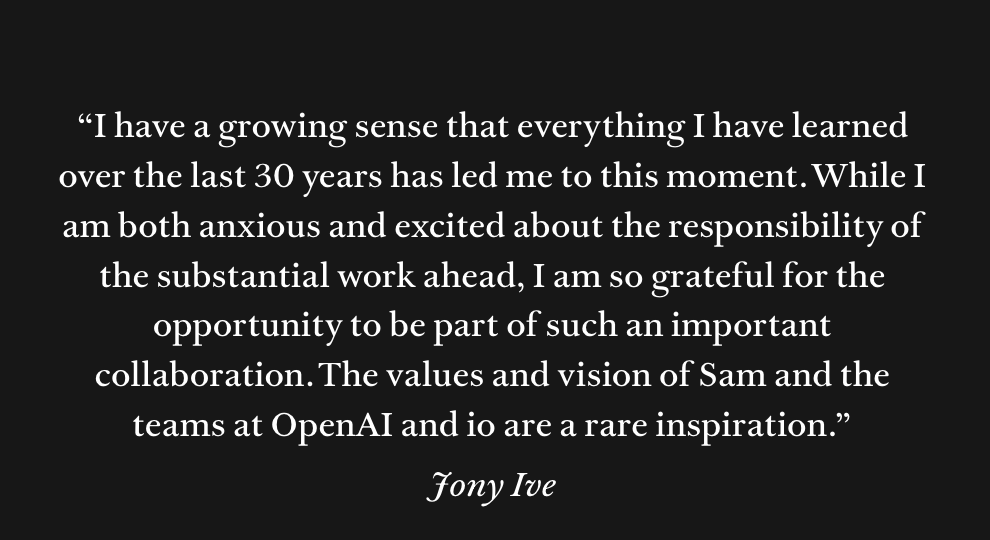
“The values and vision of Sam and the teams at OpenAI and io are a rare inspiration,” Ive said in a statement that should terrify every other tech CEO. When the designer of the iPhone calls your vision “rare inspiration,” you’ve achieved something approaching the impossible.
But here’s what makes this move truly extraordinary: Altman didn’t just recruit Ive. He convinced him to start from scratch.
While competitors played catch-up, Altman played chess
To understand the brilliance of Altman’s strategy, consider how spectacularly his competitors have fumbled the AI revolution:
Microsoft became a fast follower with no vision beyond integration. Despite investing $13 billion in OpenAI, they’ve produced nothing but Copilot features—essentially ChatGPT dressed up in Office clothes. Their “innovation” extends to adding AI chat boxes to existing workflows. Revolutionary? Hardly.
Apple, once the industry’s innovation north star, has gone dark. Their AI strategy consists entirely of Apple Intelligence—a collection of catch-up features that feel obligatory rather than transformative. The company that once “thought different” now thinks exactly like everyone else, just slower.
Google possesses world-class AI research but catastrophic execution. Their models rival OpenAI’s technically, yet AI Studio and Gemini remain niche products while ChatGPT became a cultural phenomenon. Google knows how to build incredible technology; they’ve forgotten how to make people love it. (Notebook LM is the rare Google win, but not sure if the product sticks around)
While these tech titans stumbled through incremental updates, Altman was quietly orchestrating a two-year courtship of the world’s most influential product designer. The result: a partnership that redefines the competitive landscape overnight.
The two-year seduction
The Ive recruitment wasn’t a typical Silicon Valley hiring blitz. Altman played a longer game, one that reveals his sophisticated understanding of visionary talent.
Their collaboration began two years ago with conversations about “what the future of AI and new kinds of computers was going to look like.” Altman didn’t pitch Ive on joining OpenAI. Instead, he created conditions for a genuine creative partnership to emerge.
“A collaboration built upon friendship, curiosity and shared values quickly grew in ambition,” the companies said in their joint statement. Translation: Altman spent two years proving to Ive that AI represented the next paradigm shift worthy of his attention—as significant as the transition from keyboards to touchscreens.
The strategy worked. Ive now speaks about their partnership with the enthusiasm he once reserved for Apple’s moonshots: “I have a growing sense that everything I have learned over the last 30 years has led me to this moment.”
The strategic devastation
Altman’s move represents a triple blow to competitors: he’s secured the industry’s premier design team, removed them from every rival’s recruiting pool, and positioned OpenAI to define AI hardware from first principles. While others optimize existing interfaces, Altman is reimagining them entirely.
The psychological impact may prove even more damaging. Altman has demonstrated that the world’s most sought-after talent wants to build the future with him, not optimize the past for legacy tech giants.
Why Sam Altman leads while others follow
The Ive partnership crystallizes what separates Altman from his peers: he consistently creates new categories rather than improving existing ones.
Consider OpenAI’s track record under his leadership. ChatGPT didn’t just advance chatbots—it invented conversational AI as a consumer category. GPT-4 didn’t just improve language models—it made artificial general intelligence feel inevitable. Now, partnering with Ive, Altman isn’t just building better AI tools—he’s reimagining how humans interact with intelligence itself.
“Our experience remains shaped by traditional products and interfaces” despite AI’s unprecedented capabilities, Altman observed. While competitors accept this limitation, he’s recruiting the talent to transcend it.
The approach reveals Altman’s core advantage: he thinks in decades, not quarters. The Ive partnership isn’t about this year’s product roadmap—it’s about owning the next era of human-computer interaction.
The innovation vacuum
Perhaps most damning is how Altman’s success highlights his competitors’ creative bankruptcy.
Microsoft, despite its OpenAI investment, has produced no original AI vision beyond “ChatGPT, but in Excel.” Apple, the company that convinced consumers they needed devices they didn’t know existed, now struggles to explain why anyone needs Apple Intelligence. Google has relegated breakthrough AI research to modest product improvements.
Meanwhile, Altman continues attracting visionaries who want to reshape reality, not refine spreadsheets.
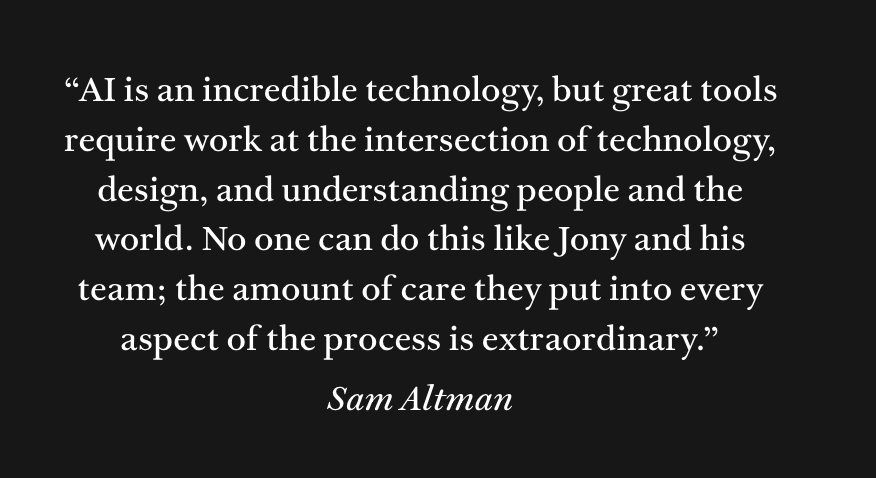
“AI is an incredible technology, but great tools require work at the intersection of technology, design, and understanding people and the world,” Altman said. “No one can do this like Jony and his team.”
That’s not just a compliment—it’s a strategic thesis. While competitors treat AI as a feature to be integrated, Altman treats it as a platform for reimagining human potential.
The future taking shape
As the tech industry processes this seismic shift, one reality becomes undeniable: there’s Sam Altman’s OpenAI, and then there’s everyone else trying to catch up.
The Ive partnership represents more than exceptional recruiting—it’s proof of exceptional leadership. In an industry filled with capable managers optimizing existing products, Altman stands alone as a leader creating tomorrow’s realities.
“I am reminded of a time, three decades ago, when I emigrated to America,” Ive reflected. “As a designer, I was drawn to the exhilarating and innocent optimism of Silicon Valley, to collaborate with people driven to create amazing products that elevate humanity.”
That optimism, it turns out, now has a home at OpenAI. And Sam Altman is its architect.

Sam Altman and Jony Ive video discussion in San Francisco CA
Anthony Batt has been running an AI-first frontier product for the past year at CO/AI and podcasting Vibe Working. With extensive experience as a technology and product executive, Batt has founded and worked for several venture-backed startups, giving him firsthand insight into the transformative impact of AI on business operations and strategy
Recent Blog Posts
Elon Musk Doesn’t Run Six Companies. He Runs One Router.
On Wednesday morning, Andrej Karpathy — the man who taught a generation of engineers to build neural networks — told everyone to stop writing code. Manage the agents that write it, he said. The guy who wrote the playbook just rewrote it. We covered the implications in our Signal/Noise briefing: who builds the Cisco for agents, what happens when agents get wallets, why the Fastenal vending machine is the best metaphor for the AI economy. But the more we pulled on the thread, the more a different question emerged. Not about code. Not about models. About organizations. Specifically: what does a...
Mar 3, 2026Stop Boarding Up the Windows. The Tsunami Is Coming.
There's a popular narrative about AI and jobs right now. It goes something like this: AI is coming for your job. Companies are laying people off. The robots are winning. It's not wrong, exactly. But it's dangerously incomplete — like watching a hurricane through your living room window and thinking the problem is the wind. When a hurricane hits, the first thing you notice is the wind. Trees bending, debris flying, power lines snapping. It's dramatic and visible and it's what every camera crew points at. Then comes the rain — relentless, overwhelming, the kind that makes you question every...
Feb 24, 2026The command line didn’t die. It was waiting.
There's a moment every programmer remembers. Not when they learned to code — that's a different memory, usually involving a textbook and a lot of frustration. I mean the moment when the terminal stopped feeling like a place you visited and started feeling like a place you lived. For me, that moment happened twice. Once in my early twenties, bent over a keyboard writing Bash scripts, watching the Unix command line respond to me like a conversation. And then again, exactly one year ago, when I typed my first prompt into Claude Code and felt that same electricity — something on...