
What Did You Do Today?
AI isn't creating a meaning crisis. It's exposing the one we've been living in for decades.
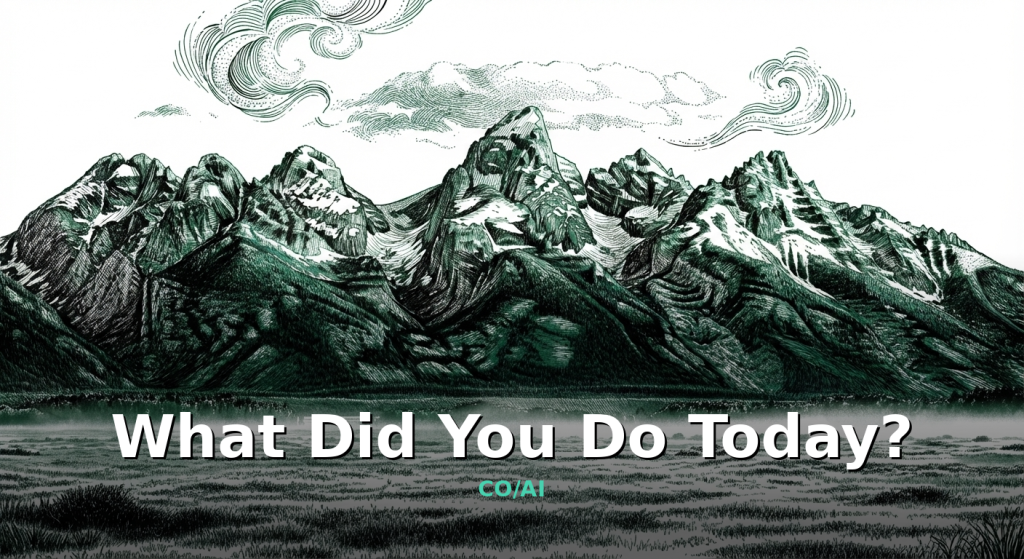
There’s a saying in Jackson Hole. You hear it at the coffee shop on the square, on the chairlift at the Village, in the bars after a day on the mountain. It goes like this:
It’s not what you do. It’s what you did today.
I’ve been thinking about that line all weekend. Because Sam Lessin dropped a piece arguing that AI isn’t just a labor crisis — it’s a meaning crisis. And Goldman Sachs just published 40 years of data proving that when technology displaces workers, the damage doesn’t heal. It scars. Ten percent slower earnings growth for the next decade. Delayed homeownership. Lower marriage rates. A wound that stays open long after the job listing disappears.
Lessin is right about the diagnosis. But I think he’s got the prescription backwards. And I think a guy who quit being a CMO to climb rocks in Boulder, a George Clooney movie from 2009, my golf swing, and my wife’s crossword puzzle habit can explain why.
The Scar That Doesn’t Fade
Let’s start with the data, because the data is brutal.
Goldman Sachs economists Pierfrancesco Mei and Jessica Rindels drew on four decades of individual-level records to measure what happens to workers displaced by technology — not just in the first year, but over the following decade. The findings are stark. Over ten years, real earnings for technology-displaced workers grow nearly ten percentage points less than for workers who were never displaced, and five percentage points less than for workers displaced by other causes. In the immediate aftermath, tech-displaced workers take about a month longer to find work and suffer more than three percent lower real wages when they do. And if you lose your job to technology during a recession, the gap widens by roughly three additional weeks of unemployment and five percentage points higher risk of dropping out of the labor force entirely.
This isn’t abstract. This is someone’s mortgage. Someone’s kid’s college fund. Someone’s marriage.
And it’s accelerating. A Fortune report from February noted that over 100,000 tech workers were laid off in 2025 alone, with AI cited as the primary driver in more than half the cases. Block cut nearly half its 10,000-person workforce, with Jack Dorsey stating flatly that AI had made many of those roles unnecessary. CFOs surveyed by Fortune admitted privately that AI-related layoffs will be nine times higher this year than last — and still a fraction of what they expect is coming.
A research paper published on arXiv — “The AI Layoff Trap” — frames the problem with mathematical precision. Displaced workers are also consumers. When their lost income is not replaced, each round of layoffs erodes the purchasing power all firms depend on. Each company’s decision to automate is rational in isolation. Collectively, they’re sawing through the branch they’re sitting on. Firms automate their way to boundless productivity and zero demand. A collective action problem dressed up as an efficiency gain.
Forrester’s 2026 predictions found that 55% of employers already regret laying off workers for AI. Think about that. More than half. And it’s April.
The Meaning Crisis That Isn’t
So here comes Lessin with the thesis that young people are drawn to almost religious narratives about AI — both utopian and apocalyptic — because they want their lives to feel like they matter. They want something that topples the checkerboard, because the social implications of this moment feel scary and bad. The old pathways — get the degree, get the job, climb the ladder, retire with a watch and a pension — are dissolving in real time, and nothing has emerged to replace them.
I get it. I really do.
But I think the framing is backwards. It’s not a meaning crisis. It’s a misplaced meaning crisis. And the distinction matters enormously for what comes next.
For decades, we’ve conflated employment with identity. “What do you do?” is the first question at every dinner party, every networking event, every awkward conversation at your kid’s school pickup. As though the answer defines the person. As though shuffling papers or building spreadsheets or sitting in the same chair in the same office with the same people for the 5,000th consecutive work day is the thing that makes a life worth living. The gold watch, the retirement party, that’s not a life.
It never was. We just pretended it was because the paycheck was steady and the alternative was too frightening to consider.
AI is stripping away that illusion, and it hurts. But the illusion was always fragile. People who found meaning only in their work were always one layoff, one reorg, one industry disruption away from an existential crisis. AI just made the disruption faster and more visible.
And maybe — maybe — that’s a really good thing. Because “what do you do?” should have always been “what did you do today?” Or even better: “what do you enjoy doing?”
The Wake-Up Call
There’s an absolutely epic scene in Up in the Air. George Clooney has just fired J.K. Simmons — a middle-aged father named Bob who is, justifiably, upset. And Clooney’s character does something unexpected. He looks at Bob’s resume and notices a detail: a minor in French Culinary Arts. A lifetime ago, Bob wanted to be a chef. Instead he took the safe job, the steady paycheck, the path that led to a cubicle and a termination meeting with a man who flies 300,000 miles a year telling people their lives are about to change.
Clooney asks him: “How much did they first pay you to give up on your dreams?”
And then: “I see guys who work at the same company their entire lives. Guys exactly like you. They clock in, they clock out, and they never have a moment of happiness. You have an opportunity. This is a rebirth.”
It’s a movie. It’s a scripted moment designed to make you feel something in a theater. But it lands because it’s true. The displacement is real. The pain is real. And the opportunity — the ugly, unwanted, terrifying opportunity — is also real.
AI is going to be a wake-up call for a staggering number of people. It is going to create a spectacular amount of displacement. The Goldman data proves the scars will be deep and long. But embedded in that disruption is a question that most people never get around to asking until it’s too late: What would you actually do with your time if nobody was paying you to do something else?
The Guy Who Answered the Question
Kevin Dahlstrom answered it.
Dahlstrom was a four-time CMO. He successfully rebranded three public companies. He had the career that MBA programs put on brochures — the corner office, the Porsche, the Dallas zip code. And it became hollow.
He describes a moment — a $150 million mansion meeting — where he looked around and realized that the life he was building wasn’t the life he wanted to live. Not even close. So he developed an exercise he calls the “ideal end state.” You sit down and bullet out what your ideal life actually looks like. Not achievements. Not titles. Not net worth. Who would you be around? What would you do with your time? Where would you be? How would things feel?
Most people, he says, discover that what they actually want costs far less than they think. They want freedom. They want control of their time. They want to be outside, or with their family, or learning something that excites them. They don’t want the corner office. They want Tuesday mornings.
Dahlstrom picked up and moved to Boulder. Got deeply into rock climbing. Hard physical work. Demanding. The kind of thing where you can feel yourself improving — grip strength, route reading, the ability to hold a position on the wall that would have been impossible six months ago. And he works every day to get better at it, and to get other people to follow his lead. To define their own ideal end state and then actually chase it.
His whole message on X — @camp4, if you want to follow him — boils down to: get out of the rat race. Get into nature. Find things you love. Find meaning in them.
And here’s the thing: he’s 120% correct.
The Golf Swing and the Crossword
I know he’s not wrong because I’ve lived it. Twice, this past weekend.
I’ve struggled with my driver for years. A severe out-to-in, over-the-top move that turned every tee shot into an adventure I didn’t sign up for. This winter I committed to changing my swing completely — moved to a single-plane approach, rebuilt muscle memory from scratch, ground through the ugly middle phase where everything felt wrong and every range session ended in frustration. You know that phase. The one where you’re worse than when you started and you begin to wonder if the whole project was a mistake.
This past weekend, three rounds in, I piped drives into places on the course I’ve never seen. One guy in my foursome said, “I’ve never seen anybody so happy with a drive.” He was right. I was beaming. Because I’d earned it through months of deliberate, frustrating, sometimes humiliating work. I’d improved – and it will breed further improvement.
My wife is a crossword puzzle expert. She competed in the ACPT this weekend — the American Crossword Puzzle Tournament, the largest serious crossword competition in the country. These are the people who finish the Saturday New York Times puzzle in eight minutes. She came out 190th in the nation. Her best showing ever. She’s been working at this for years — grinding, improving, studying patterns. She was thrilled.
Neither of those achievements will ever appear on a resume. No employer will ever care. No AI will ever take them away. And both of them provided more genuine meaning this weekend than any quarterly earnings report, product launch, or LinkedIn milestone post ever could.
The Desire to Improve
Here’s what I keep coming back to.
Meaning has to come from within. And I believe — deeply, in my bones — that meaning comes from the desire to improve. It doesn’t matter what the improvement is. Where it comes from. In what direction it’s pointed.
Improvement could come from getting better at golf. Or crosswords. It could come from expanding your vocabulary, or educating yourself on AI trends, or learning to cook something that actually impresses people. It could come from getting stronger, or more patient, or more present with your kids. It could come from building something with your hands, or writing something that surprises you, or running a mile faster than you did last month.
The American Dream was built on this idea. The proposition that you could work at it and do better than the previous generation. That effort compounds. That struggle has a payoff. And that Dream is in serious danger right now — not because AI is replacing jobs, but because we let the Dream get hijacked by corporate ladder-climbing and we forgot what it was actually about.
The Dream was never “get a better cubicle than your parents.” It was: improve. Get better. Push further. Leave something behind that matters.
AI has done nothing to help the employment version of that Dream. But it has brought a staggering array of improvements and potential improvements to everyone with a smartphone. You can learn almost anything, practice almost anything, get feedback on almost anything — faster and cheaper than at any point in human history. The tools for self-improvement have never been more accessible. The irony is that the same technology displacing workers is also handing them the most powerful self-improvement toolkit ever created.
The Rebirth
So when someone asks you — what did you do today?
The answer should be: I improved myself.
Not “I went to work.” Not “I sat in meetings.” Not “I shuffled the same papers I’ve been shuffling for a decade.” I improved. I got a little better at something I care about. I struggled with something hard and made progress. I chose a direction and took a step.
Ryan Bingham — Clooney’s character in Up in the Air — was cynical about almost everything. He lived in airports. He had no roots, no commitments, no home that felt like one. But he saw something real in that firing scene. He saw a man who had abandoned his own dreams so gradually that he’d forgotten he ever had them. And he saw the displacement not as an ending but as a rebirth.
AI is going to force that rebirth on millions of people who didn’t ask for it and aren’t ready for it. The scarring will be real — Goldman proved that with four decades of data. The economic pain will be immense. The collective action problem identified in “The AI Layoff Trap” is not theoretical — it’s playing out in real time across every sector of the economy.
But.
Kevin Dahlstrom was a four-time CMO who found meaning on a rock wall in Boulder. My wife found it in a crossword grid at the ACPT. I found it in a golf swing I’d been fighting for years. None of us found it in a job title. None of us found it in a paycheck. And none of us will lose it when the next wave of automation hits.
The revolution can eat every moat in Silicon Valley. It can commoditize voice, code, images, and analysis overnight. It can displace a hundred thousand workers in a quarter and leave scars that last a decade.
But it can’t touch the thing you chose to struggle for. That’s yours.
So ask yourself — honestly, uncomfortably, right now:
If AI took your job tomorrow, do you know what you’d do with the time? Not what LinkedIn posting you’d write. Not what recruiter you’d call. What you’d actually do. What struggle you’d choose. What skill you’d grind on. What pursuit would make you feel the way I felt when I finally piped that drive into the middle of the fairway after months of ugly work.
If you don’t have an answer, finding one is more urgent than updating your resume.
It’s not what you do. It’s what you did today.
Make sure you have something worth saying.
— Harry
Recent Blog Posts
The Livestream That Made 543,000 People Realize We’re Cooked
I was one of the 543,000 people that watched robots work a warehouse shift on a live stream and nobody was celebrating. That's the thing nobody talks about when they imagine the future. They talk about the economics. The efficiency gains. The disruption. What they don't talk about is how eerie it would feel to actually watch it happen in real time. On May 8th, 2025, Figure AI livestreamed humanoid robots—Helix-02 units—doing a full 8-hour shift in a warehouse. Fully autonomous. No human intervention. No puppeteers. No prerecorded segments. A live production run being broadcast with a timestamp and viewer...
May 13, 2026Apple’s Real Move and Why They Win The AI Race
I've been an Apple user since the Apple II. I remember the rainbow cable. I was in the line for the early all-in-one Macintosh. I've built software for the Mac and iOS for decades. I own a Vision Pro. I'm not a casual observer. Which is why I can tell you what I think is actually happening at Apple right now has almost nothing to do with what the tech press thinks. Tim Cook didn't step down. He stepped away from an argument he lost. On the surface, the succession reads clean: Cook becomes executive chairman. John Ternus, a hardware...
May 5, 2026Diamond Hands Are Bidding On Pez Dispensers. The Husks Are About To Run.
So here's what happened over the weekend. Ryan Cohen — the activist who turned GameStop from a dying mall retailer into the original meme stock, the patron saint of "to the moon" and "HODL" and the whole 2021 retail-revenge tableau — walked into The Wall Street Journal and announced an unsolicited $56 billion bid for eBay. Cash and stock. $125 a share. The bid is backed by GameStop's roughly 5% existing stake in eBay, $20 billion of debt-financing committed by TD Bank, $9 billion of cash on the GameStop balance sheet, and the residual halo of a stock that still...